Use a cautious sequence to separate an outage, tripped GFCI, overloaded circuit, appliance fault, or wiring problem—without opening a panel or defeating protection.
Looking for verified electrical specialists? Check availability in seconds.
Check ZIP code availabilityFirst decide whether this is an emergency
Do not begin with the breaker panel. Look, listen, and smell from a safe distance. If you see smoke or fire, hear active arcing, or believe fire is inside a wall or panel, get everyone out and call 911. Do not use water on an electrical fire and do not touch equipment to investigate.
Keep away from any panel, device, appliance, or cord that is wet, flood-exposed, visibly damaged, sparking, unusually hot, buzzing, crackling, discolored, melted, or producing a burning or fish-like odor. Do not stand in water to reach a switch or breaker. Call the utility for damaged service equipment or lines and a qualified electrician for building wiring; emergency services may also be appropriate.
Any shock or tingling is a stop condition, even if the device still works. Do not retest it. Disconnect power only from a dry, undamaged, safely reachable control; otherwise stay away. Seek urgent medical guidance after an electrical shock, and call 911 for severe symptoms or immediate danger.
Step 1: map what lost power without taking anything apart
If no emergency sign is present, determine the boundary. Is one receptacle dead, one half of it dead, several outlets and lights in one area off, one large appliance off, or much of the home abnormal? Check whether clocks, lights, and receptacles elsewhere work. Do not remove a cover plate, insert a tester into damaged equipment, or open the panel’s dead front.
Check the utility’s official outage map or outage line if the whole home is dark, neighbors are affected, or exterior utility equipment appears damaged. A main disconnect that will not stay on, partial power across unrelated rooms, abnormally bright and dim lights, or several 240-volt appliances failing can indicate a service problem; unplug sensitive electronics when safe and contact the utility and an electrician promptly.
Some receptacles are intentionally controlled by a wall switch, and some duplex receptacles have only one switched half. Check familiar switches once. Do not repeatedly toggle one that is warm, noisy, loose, or discolored.
Step 2: turn off or unplug connected loads
Switch off lights and unplug accessible appliances on the affected circuit before a reset. Pull by the plug, not the cord, and do not touch a damaged or overheated plug. Leave hardwired equipment alone. This prevents an unattended motor, heater, or tool from restarting and removes a possible appliance fault or overload.
If the trip occurred when several high-wattage appliances ran together, an overload is plausible. Reduce simultaneous use and arrange an electrician’s evaluation if normal use repeatedly exceeds the circuit. If one appliance repeatedly precedes the trip, stop using it and have it repaired or replaced. Do not move the suspect appliance to another circuit for testing; that transfers a possible shock, short, or fire hazard.
Step 3: check the relevant GFCI from a dry location
A GFCI protects people by opening the circuit when it detects current leaking from its intended path. One GFCI receptacle or breaker can protect ordinary-looking receptacles downstream, so the device may be in a nearby bathroom, garage, kitchen, basement, laundry area, crawlspace access, or exterior location rather than beside the dead outlet.
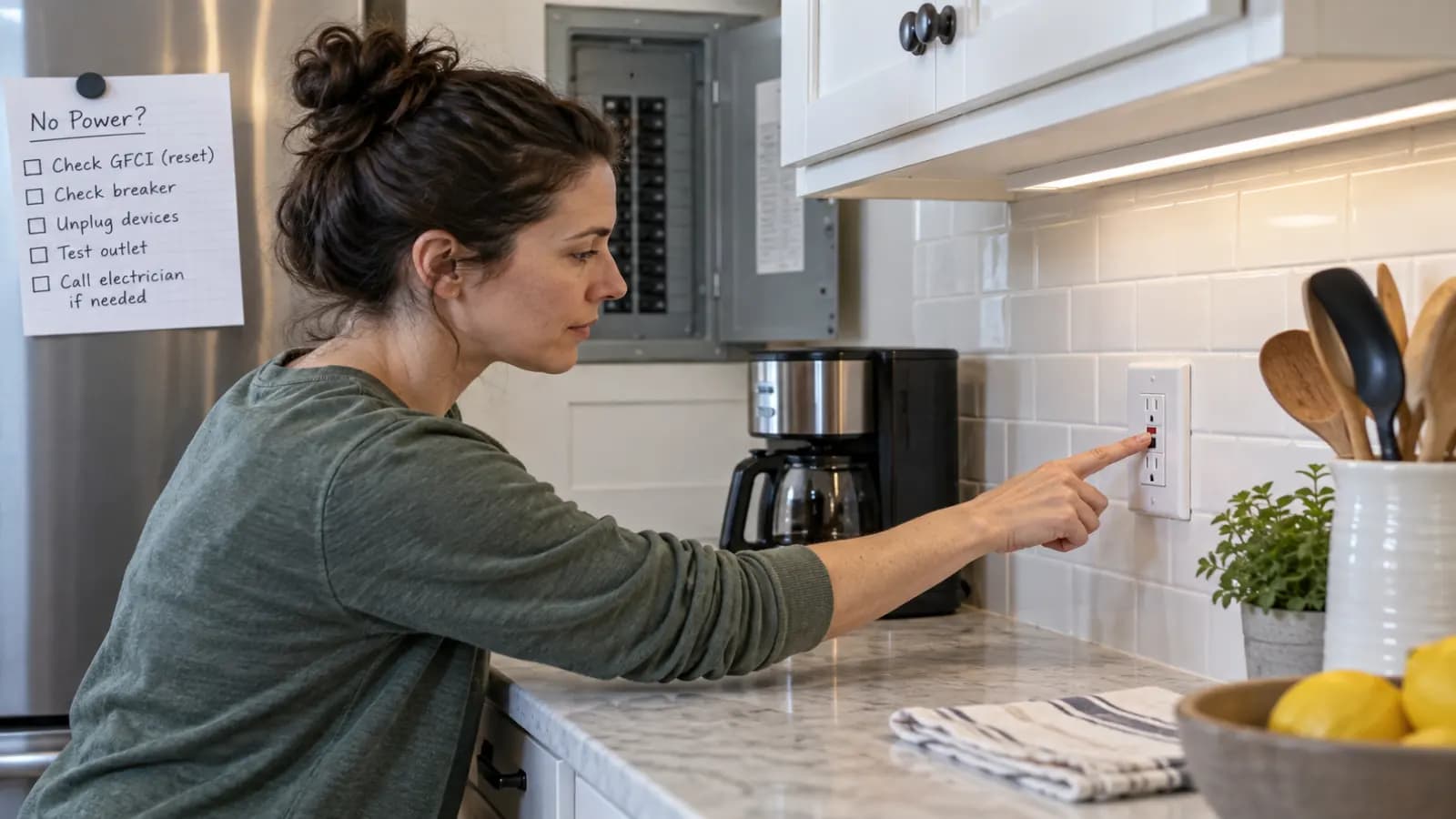
Look for a clearly related GFCI with TEST and RESET buttons. If it and the area are completely dry, undamaged, cool, and odor-free, and loads are off, press RESET once. If it will not reset, immediately trips again, feels abnormal, or power remains off, stop. Do not hold or tape the button, replace it during triage, or search wet and inaccessible spaces.
ESFI recommends monthly GFCI testing with the manufacturer’s TEST and RESET controls. Routine testing is different from repeatedly resetting after a fault. If TEST does not remove power or RESET does not restore it under normal dry conditions, have a qualified electrician diagnose or replace it.
Step 4: reset a tripped branch breaker once
Approach only a panel that is dry, intact, normally cool, quiet, and free of odor, corrosion, missing covers, or exposed parts. Stand on a dry surface with dry hands. Open only the hinged door used for breaker handles; never remove screws or the dead-front cover. If anything looks or sounds wrong, call an electrician.
A tripped handle may sit between ON and OFF. After loads are off, move the identified branch breaker fully to OFF and then to ON once, following its instructions. Stand to the side rather than directly in front. Do not reset the main, operate an unidentified disconnect, or touch a fuse system as part of this guide.
If it will not latch, trips immediately, trips again after loads return, or cannot be identified confidently, leave it off. Never install a larger breaker, substitute a different fuse, block a handle, or bypass AFCI or GFCI protection. CPSC specifically warns against using higher-amperage protection to stop trips.
Step 5: restore loads one at a time only if power stays stable
If one permitted reset restores power and no warning appears, reconnect only undamaged loads one at a time. Stop if a device causes a trip, odor, sound, flicker, heat, or shock. Leave it unplugged and arrange service. Do not continue the experiment with a sump pump, medical device, HVAC equipment, or other critical hardwired load; call the appropriate professional.
A circuit that holds only after several devices are removed may have been overloaded, but loose connections and equipment faults can also be intermittent. Treat frequent trips, unexplained dead outlets, or recurring resets as reasons for diagnosis, not as a household ritual.
What standard, GFCI, AFCI, and dual-function trips mean
A standard breaker protects conductors against overcurrent from overloads and short circuits. A GFCI responds to leakage that can create shock risk. An AFCI responds to signatures associated with dangerous arcing in wiring, connections, cords, or equipment. A dual-function device combines arc-fault and ground-fault protection.
The device has detected a condition; its handle alone does not identify the exact cause. Moisture, damaged cords, failed appliances, compromised wiring, overloads, shorts, installation issues, equipment incompatibility, and a defective protective device are possibilities. Calling an AFCI trip “nuisance” before diagnosis can hide a real arc fault.
Some breakers provide an indicator or diagnostic sequence. Record the brand, label, indicator, loads operating, weather, and reset result, but do not remove the cover or perform energized measurements. Give that record to the electrician.
Why one dead outlet can affect several rooms
Branch-circuit wiring often passes through multiple boxes, and downstream devices can lose power when an upstream GFCI trips or a connection fails. Circuit boundaries do not always follow rooms: a garage GFCI may protect an exterior outlet, and another device may protect a nearby location depending on design and code era.
That does not justify opening outlets until power returns. A loose connection can generate heat even when the dead receptacle looks normal, and CPSC notes that an unused outlet may become hot because power for downstream devices passes through its connections. An electrician can trace and test the circuit safely.
Who to call and what information to provide
Call 911 for fire, smoke, active arcing, a downed energized line, or immediate danger. Call the utility for a neighborhood outage, damaged service drop, meter or utility-side concern, or dangerous line condition. Call a qualified electrician for repeated trips, protection that will not reset, partial-power symptoms, unexplained dead devices, heat, odor, sound, discoloration, water exposure, shock, or wiring damage.
An appliance technician may be appropriate after the supply is found sound and one appliance is isolated. Renters should notify the landlord or emergency maintenance contact promptly and keep written records, while still contacting emergency services or the utility directly for immediate hazards.
Write down the time, affected rooms, what was running, weather or water involvement, which device tripped, whether one reset was attempted, and what happened. Photograph labels and visible damage from a safe distance. Note recent construction, appliances, drilled walls, pest activity, or leaks.
Prevent repeat trips without defeating protection
Use major and heat-producing appliances according to instructions and plug them directly into appropriate permanent receptacles. Do not use extension cords as permanent wiring, run them under rugs, or use adapters to make one circuit carry more. Replace damaged cords and stop using loose or discolored receptacles.
Keep the panel directory accurate, test GFCI and AFCI devices at the interval stated by their manufacturer, and test smoke alarms monthly. If normal use routinely overloads a circuit, ask an electrician about another circuit or broader assessment instead of rearranging the overload indefinitely.
The bottom line
Safe triage is deliberately short: screen for danger, map the outage, remove loads, reset one dry and undamaged GFCI or branch breaker once, then stop if protection will not stay set or any warning appears. Do not open equipment, upsize protection, or keep testing a suspected fault.
If you need electrical diagnosis, submit your ZIP code and symptoms to request a free match with independent local electricians. Verify licensing, insurance, permit requirements, and the written repair scope before hiring; there is no obligation to select a matched provider.
Frequently asked questions
Why are my outlets dead but the breaker is not tripped?
A tripped upstream GFCI, switched receptacle, failed connection, device fault, or less-obvious breaker position may be involved. Check for a related dry, undamaged GFCI and familiar wall switch, but do not open outlets or the panel. If one safe reset does not restore power, call an electrician.
How many times can I reset a tripped breaker?
For homeowner triage, once—only after loads are off and only if the panel is dry, intact, cool, quiet, and odor-free. If the breaker will not latch or trips again, leave it off and call an electrician. Repeated resets can reenergize a short, arc, overload, or faulty appliance.
Why does my GFCI outlet keep tripping?
Possible causes include moisture, current leakage from an appliance, damaged wiring or cords, installation problems, or a failed GFCI. Unplug accessible loads and attempt one reset only under dry, undamaged conditions. If it trips again or will not reset, stop and arrange electrical diagnosis.
Is a warm outlet dangerous?
Unusual warmth can indicate overload, a loose connection, or another unsafe condition. Stop using it and call an electrician. Do not remove the cover or assume an unused outlet is safe; power for downstream devices may pass through its connections.
Should I install a larger breaker if it keeps tripping?
No. The breaker is sized to protect circuit conductors and equipment. A larger breaker can allow unsafe current and overheating. An electrician must identify the cause and determine whether repair, load reduction, a new circuit, or another code-compliant change is appropriate.
This guide is general information, not a repair manual or a safety certification. Anything involving gas, live circuits, structural framing or standing water belongs with a licensed provider. GetLocalExperts is a free matching service and does not perform home services.
Sources and further reading
- Guide to Home Wiring Hazards — U.S. Consumer Product Safety Commission
- Understanding Your Home Electrical System — Electrical Safety Foundation International
- Ground Fault Circuit Interrupters — Electrical Safety Foundation International
- How to Use GFCIs — Electrical Safety Foundation International
- Don't Overload Your Home — Electrical Safety Foundation International
- Appliance Safety Tips — Electrical Safety Foundation International
This guide was researched and reviewed by the GetLocalExperts Editorial Team against primary regulatory benchmarks, state contractor licensing board standards, and FTC consumer protection guidelines.